

Amyloidosis Therapeutics Market to Surpass USD 6.3 Billion by 2035 as Precision Medicine and Novel Drug Development Accelerate Treatment Innovation
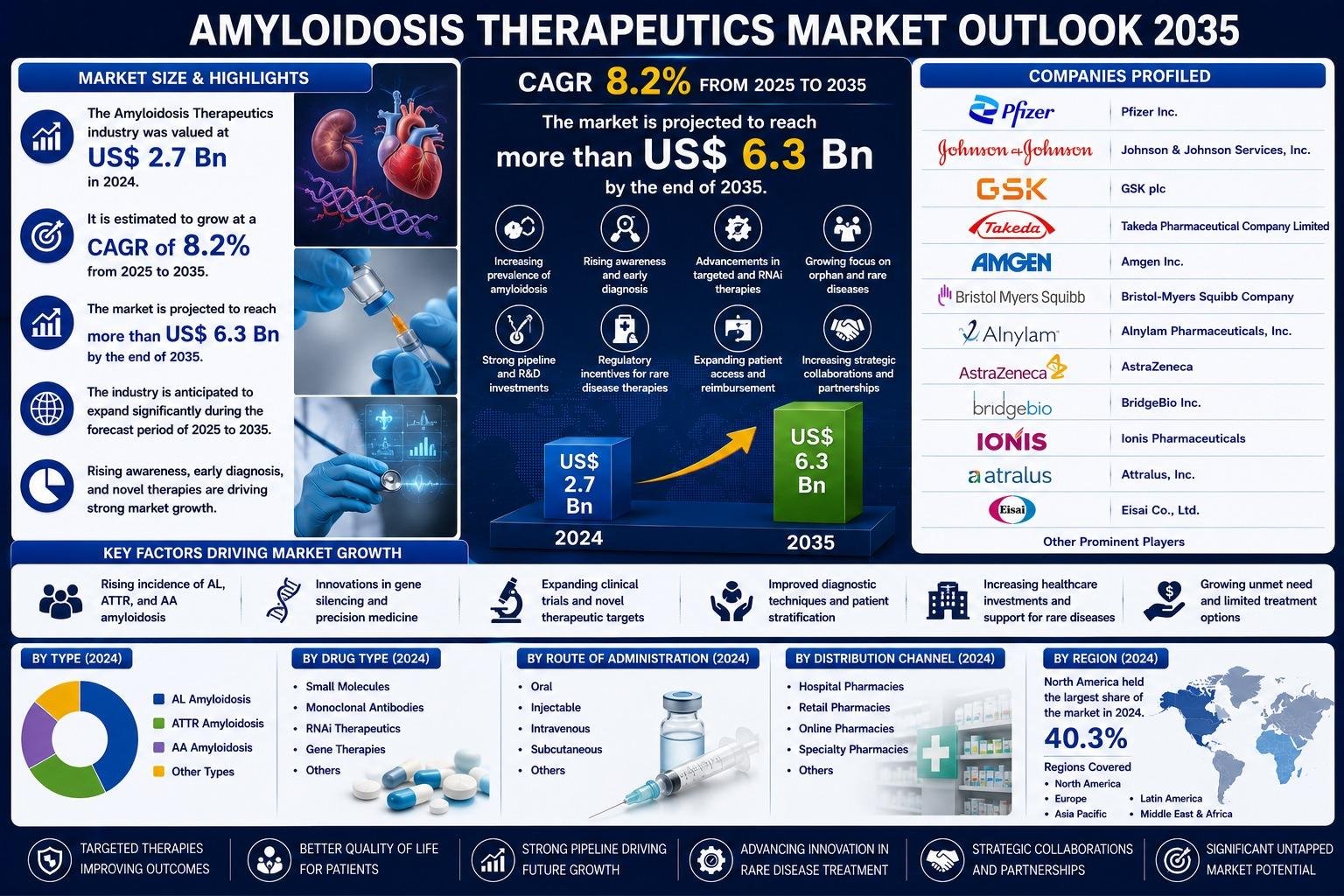
The global Amyloidosis Therapeutics Market is experiencing significant growth as increasing disease awareness, advances in diagnostic technologies, and rapid progress in targeted drug development transform the treatment landscape for this rare but life-threatening disorder. Pharmaceutical companies are investing heavily in innovative therapies designed to slow disease progression, improve organ function, and enhance patient survival, creating new opportunities across the global healthcare industry.
According to industry estimates, the Amyloidosis Therapeutics Market was valued at US$ 2.7 Billion in 2024 and is projected to exceed US$ 6.3 Billion by the end of 2035, expanding at a compound annual growth rate (CAGR) of 8.2% from 2025 to 2035.
The market is benefiting from increasing prevalence of amyloidosis, growing adoption of personalized medicine, expanding clinical research activities, favorable regulatory support for orphan drugs, and continuous innovation in monoclonal antibodies, RNA interference (RNAi) therapeutics, transthyretin stabilizers, and gene-editing technologies.
Rising Prevalence of Amyloidosis Drives Market Growth
The growing incidence of amyloidosis remains one of the primary factors fueling expansion of the global Amyloidosis Therapeutics Market.
Amyloidosis is a rare disease characterized by abnormal protein deposits known as amyloid fibrils that accumulate within tissues and vital organs such as the heart, kidneys, liver, nervous system, and gastrointestinal tract. These deposits gradually impair normal organ function and can become life-threatening if left untreated.
Improved clinical awareness among physicians, advances in diagnostic imaging, biomarker testing, and genetic screening have significantly increased diagnosis rates worldwide.
Among various forms of the disease, light-chain (AL) amyloidosis remains the most commonly diagnosed systemic type, accounting for nearly 70% of systemic amyloidosis cases globally.
According to clinical estimates, approximately 4,000 new AL amyloidosis cases are diagnosed annually in the United States, with most patients identified between 50 and 65 years of age.
The increasing prevalence of chronic diseases such as multiple myeloma, chronic inflammatory disorders, and plasma cell dyscrasias further contributes to rising patient populations requiring specialized amyloidosis treatment.
Earlier diagnosis allows physicians to initiate therapy before irreversible organ damage occurs, substantially improving long-term clinical outcomes and expanding demand for advanced therapeutics.
Growing Investment in Research and Development Accelerates Innovation
Continuous investments in pharmaceutical research and biotechnology innovation are transforming the amyloidosis treatment landscape.
Global pharmaceutical companies, biotechnology firms, academic research organizations, and government agencies continue investing heavily in developing disease-modifying therapies capable of addressing the underlying mechanisms responsible for amyloid protein deposition.
Modern research increasingly focuses on therapies capable of preventing amyloid formation, stabilizing disease-causing proteins, enhancing immune-mediated clearance of amyloid deposits, and repairing damaged organs.
Several breakthrough technologies—including RNA interference (RNAi), antisense oligonucleotides, monoclonal antibodies, CRISPR-based gene editing, and precision medicine approaches—are demonstrating encouraging clinical outcomes.
Clinical development pipelines remain particularly active for transthyretin amyloidosis (ATTR) and AL amyloidosis, with multiple investigational therapies progressing through late-stage clinical trials.
Growing collaboration between pharmaceutical companies and research institutions continues accelerating commercialization of innovative treatment options for patients worldwide.
Monoclonal Antibodies Revolutionize Treatment
Monoclonal antibodies have emerged as one of the most promising therapeutic categories within the Amyloidosis Therapeutics Market.
Unlike conventional therapies that primarily manage disease symptoms, monoclonal antibodies specifically recognize and target abnormal amyloid protein deposits, enabling immune-mediated clearance while slowing disease progression.
Their precision targeting improves therapeutic effectiveness while minimizing damage to healthy tissues.
The increasing number of regulatory approvals, expanding clinical trials, and favorable physician acceptance continue strengthening the commercial position of monoclonal antibody therapies.
Pharmaceutical companies are actively developing next-generation antibody therapies capable of targeting multiple amyloid proteins with improved efficacy and safety profiles.
These biologics are expected to remain one of the fastest-growing drug categories throughout the forecast period.
RNA Therapeutics and Precision Medicine Create New Opportunities
Precision medicine is reshaping future treatment strategies for amyloidosis.
RNA interference (RNAi) therapeutics, antisense oligonucleotides, and gene-silencing technologies are enabling physicians to address disease progression at the genetic level rather than merely managing symptoms.
These innovative therapies suppress production of disease-causing proteins responsible for amyloid formation.
Personalized medicine further enables physicians to customize treatment according to genetic mutations, disease subtype, organ involvement, and patient-specific clinical characteristics.
The increasing availability of genomic testing and molecular diagnostics supports more accurate patient stratification and individualized therapeutic decision-making.
As precision medicine continues advancing, pharmaceutical companies are expected to introduce increasingly targeted therapies capable of improving long-term survival and quality of life.
AL Amyloidosis Remains the Largest Indication Segment
Among disease indications, AL (Primary) Amyloidosis continues to account for the largest share of the global Amyloidosis Therapeutics Market.
This dominance is attributed to relatively higher diagnosis rates, significant disease burden, and urgent treatment requirements.
AL amyloidosis develops when abnormal plasma cells produce excess light-chain proteins that accumulate within vital organs, leading to progressive dysfunction.
Patients frequently experience cardiac complications, kidney failure, neuropathy, liver dysfunction, and gastrointestinal disorders.
Without timely intervention, AL amyloidosis carries a poor prognosis.
Current treatment approaches combine chemotherapy, proteasome inhibitors, monoclonal antibodies, corticosteroids, immunomodulators, stem cell transplantation, and emerging targeted therapies.
Continuous clinical innovation and improved diagnostic capabilities continue expanding treatment opportunities for this patient population.
North America Leads the Global Market
North America remains the largest regional market for amyloidosis therapeutics due to advanced healthcare infrastructure, strong pharmaceutical research capabilities, and widespread availability of specialized treatment centers.
The United States accounts for the majority of regional revenue owing to high disease awareness, favorable reimbursement policies, rapid orphan drug approvals, and significant investments in rare disease research.
Leading biotechnology companies headquartered across North America continue introducing innovative therapies supported by accelerated regulatory pathways provided by the U.S. Food and Drug Administration (FDA).
Growing participation in clinical trials, expanding patient advocacy organizations, and increasing physician education further support regional market expansion.
Europe represents the second-largest market, benefiting from strong rare disease research programs, established healthcare systems, and growing adoption of innovative biologics.
Meanwhile, Asia Pacific is anticipated to register the fastest growth during the forecast period due to improving healthcare infrastructure, increasing diagnosis rates, expanding pharmaceutical manufacturing capabilities, and greater government support for rare disease management.
Regulatory Support Strengthens Commercialization
Government agencies continue providing favorable regulatory frameworks for rare disease therapeutics.
Orphan drug designation, accelerated review pathways, priority review vouchers, and research incentives encourage pharmaceutical companies to develop innovative treatments for amyloidosis.
These regulatory initiatives reduce development timelines while improving commercial viability for manufacturers.
Growing collaboration between regulators, academic institutions, biotechnology companies, and patient advocacy organizations further accelerates clinical research and therapeutic innovation.
The supportive regulatory environment is expected to remain an important catalyst for future market growth.
Competitive Landscape
The Amyloidosis Therapeutics Market remains highly competitive, with global pharmaceutical companies investing extensively in clinical development, strategic partnerships, acquisitions, and precision medicine technologies.
Major companies operating in the market include Pfizer Inc., Johnson & Johnson Services, Inc., GSK plc, Takeda Pharmaceutical Company Limited, Amgen Inc., Bristol-Myers Squibb Company, Alnylam Pharmaceuticals, Inc., AstraZeneca, BridgeBio Inc., Ionis Pharmaceuticals, Attralus, Inc., and Eisai Co., Ltd.
These companies continue strengthening their market positions through development of monoclonal antibodies, RNA therapeutics, transthyretin stabilizers, immunotherapies, and next-generation gene-targeted treatments.
Strategic collaborations with research institutions and specialty healthcare providers further accelerate commercialization of innovative therapies.
Recent Industry Developments
Several significant developments continue shaping the Amyloidosis Therapeutics Market.
In December 2023, Ionis Pharmaceuticals and AstraZeneca received U.S. FDA approval for WAINUA (eplontersen) for treating hereditary transthyretin-mediated amyloidosis with polyneuropathy (ATTRv-PN), becoming the only approved therapy in its class that can be self-administered using an auto-injector.
In October 2024, Alnylam Pharmaceuticals submitted a supplemental New Drug Application (sNDA) to the U.S. FDA seeking approval of vutrisiran for transthyretin amyloidosis with cardiomyopathy (ATTR-CM). The application received Priority Review, reflecting the therapy's potential clinical significance.
In November 2024, the FDA accepted the supplemental application for review, representing another important milestone in expanding treatment options for ATTR amyloidosis patients.
These developments highlight continued momentum in regulatory approvals, innovative drug development, and commercialization of disease-modifying therapies.
Future Outlook
The future of the global Amyloidosis Therapeutics Market appears highly promising as advances in precision medicine, RNA-based therapeutics, monoclonal antibodies, and gene-editing technologies continue transforming patient care.
Increasing awareness of rare diseases, earlier diagnosis, supportive regulatory policies, expanding clinical research, and substantial pharmaceutical investment will continue driving market expansion over the coming decade.
As innovative therapies become more widely available and personalized treatment approaches improve clinical outcomes, the Amyloidosis Therapeutics Market is expected to experience sustained long-term growth, providing new hope for patients affected by this complex and often life-threatening disease.
 English