

Upcycled Food Ingredients Market Set to Reach USD 580.6 Billion by 2036 at 6.4% CAGR
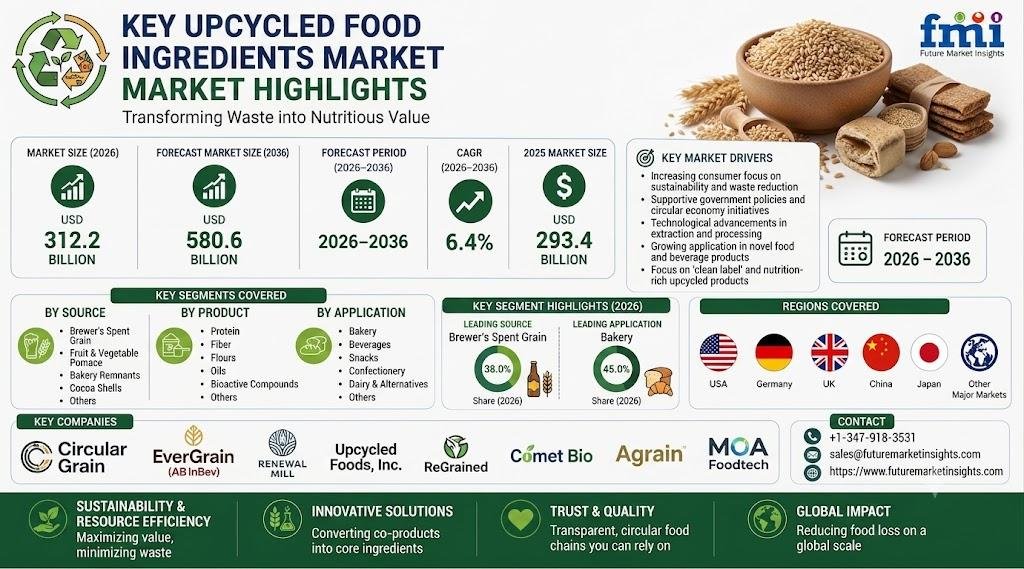
NEWARK, Del., August 3, 2026 — The global Upcycled Food Ingredients Market is projected to expand as food manufacturers increasingly recover edible side streams and convert them into commercially viable ingredients with defined nutritional, functional, and processing characteristics. According to Future Market Insights (FMI), the market is projected to grow from USD 312.2 billion in 2026 to USD 580.6 billion by 2036, registering a 6.4% CAGR during the forecast period.
👉 Request Your Free Sample Report – Get an exclusive preview of the market research, key insights, and industry analysis: https://www.futuremarketinsights.com/reports/sample/rep-gb-34199
The market is anticipated to create significant opportunities between 2026 and 2036, supported by growing food-waste reduction initiatives, increasing demand for sustainable ingredients, rising utilization of food-processing side streams, and advances in stabilization, fermentation, drying, and ingredient conversion technologies.
Key Upcycled Food Ingredients Market Highlights
· Market Size (2026): USD 312.2 Billion
· Forecast Market Size (2036): USD 580.6 Billion
· Forecast Period: 2026–2036
· CAGR (2026–2036): 6.4%
· 2025 Market Size: USD 293.4 Billion
· Leading Source: Brewer’s Spent Grain
· Brewer’s Spent Grain Share (2026): 38.0%
· Leading Product: Protein
· Protein Share (2026): 45.0%
· Leading Application: Bakery
· Bakery Share (2026): 38.0%
· Key Segments Covered: Source, Product, Application, Region
· Key Companies: Circular Grain, EverGrain (AB InBev), Renewal Mill, Upcycled Foods, Inc. (ReGrained), Comet Bio, Agrain, MOA Foodtech
Analyst Viewpoint
Nandini Roy Choudhury, Principal Analyst at Future Market Insights, stated: “Commercial confidence in upcycled food ingredients depends on converting variable food side streams into consistent ingredients that meet food-safety, sensory, and processing requirements. Companies that combine reliable feedstock access with stabilization, ingredient standardization, and application-specific formulation support are expected to strengthen their competitive position throughout the forecast period.”
Why Is the Upcycled Food Ingredients Market Growing?
Food manufacturers are increasingly seeking ways to recover edible materials that would otherwise lose value through disposal or alternative waste-management routes. Upcycling creates an opportunity to transform these side streams into proteins, fibers, flours, and other functional ingredients for food and beverage applications.
Growing food-waste reduction commitments, increasing demand for sustainable ingredients, expanding interest in circular food systems, and advances in drying, fermentation, fractionation, and stabilization technologies continue to support market growth.
Key Growth Drivers
· Rising focus on food-waste reduction
· Increasing demand for sustainable food ingredients
· Growing utilization of edible food-processing side streams
· Rising demand for alternative protein and fiber sources
· Expansion of circular food production models
· Increasing retailer and manufacturer sustainability commitments
· Advances in drying, fermentation, and fractionation technologies
· Growing adoption of upcycled ingredients in bakery and beverage products
Key Segment Insights
Why Does Brewer’s Spent Grain Lead the Source Segment?
Brewer’s spent grain remains a major source of upcycled food ingredients due to its recurring availability from brewing operations, established collection routes, and growing applications in bakery and savory food products.
Source Highlights
· Brewer’s spent grain is projected to account for 38.0% market share in 2026.
· Provides a recurring source of recovered grain material.
· Offers opportunities for protein and dietary fiber enrichment.
· Supports applications in breads, baked goods, and savory snacks.
· Established brewery networks can improve feedstock collection consistency.
· Drying and milling technologies help control moisture, particle size, and water absorption.
Why Does Protein Lead the Product Segment?
Protein is projected to remain the leading product category as food manufacturers increasingly use upcycled protein ingredients for nutrition fortification across beverages, bakery products, and other food applications.
Product Highlights
· Protein is projected to account for 45.0% market share in 2026.
· Provides measurable nutritional value across food and beverage products.
· Can be incorporated into existing formulation systems.
· Supports plant-based and nutrition-focused product development.
· Stable protein specifications help manufacturers evaluate inclusion levels.
· Dispersibility, flavor, and protein concentration remain important qualification criteria.
Why Does Bakery Lead the Application Segment?
Bakery continues to represent a major application because upcycled flours, fibers, and grain-derived ingredients can be incorporated into familiar mixing, dough, and baking processes.
Application Highlights
· Bakery is projected to account for 38.0% market share in 2026.
· Uses familiar production and dosing systems.
· Provides measurable opportunities for ingredient substitution.
· Supports applications for recovered grains, fibers, and proteins.
· Manufacturers can evaluate dough strength, water absorption, texture, and flavor through established testing procedures.
Market Dynamics
Market Drivers
Growing food-waste reduction targets, increasing demand for sustainable ingredients, expanding availability of food-processing side streams, and rising demand for protein and fiber enrichment continue to drive market growth.
Food manufacturers increasingly view recovered side streams as potential sources of saleable ingredients rather than solely as waste-management liabilities. Commercial adoption becomes stronger when processors can demonstrate consistent ingredient specifications and repeatable finished-product performance.
Market Restraints
Variable moisture, contamination risks, feedstock inconsistency, stabilization costs, transportation requirements, regulatory classification, and qualification timelines can restrain market expansion.
Wet side streams require rapid stabilization to prevent quality deterioration. Smaller processing facilities may also face limited access to drying equipment, testing laboratories, and food-grade fractionation infrastructure.
Market Opportunities
Localized conversion and distributed processing systems create opportunities to transform agricultural and food-processing residues into application-specific ingredients. Processing close to the original feedstock source can reduce transportation requirements while helping preserve ingredient quality.
Application-specific ingredients can also provide manufacturers with differentiated protein, fiber, and flour solutions that meet defined formulation requirements.
👉 Get the PDF Brochure: Discover the report’s core insights, forecast highlights, and research scope with our complimentary brochure: https://www.futuremarketinsights.com/reports/brochure/rep-gb-34199
Market Trends
Innovation continues reshaping the Upcycled Food Ingredients Market.
Major trends include:
· Growing investment in food-waste recovery technologies
· Expansion of upcycled protein ingredients
· Increasing utilization of brewer’s spent grain
· Rising demand for recovered fibers and flours
· Development of localized food-waste processing systems
· Growing application of fermentation technologies
· Increasing retailer commitments toward food-waste reduction
· Expansion of circular food manufacturing models
· Growing partnerships between ingredient developers and food manufacturers
Regional Outlook
Canada is projected to record the fastest growth among the profiled countries, expanding at a 6.7% CAGR through 2036, supported by broad agricultural feedstock availability and established cereal and oilseed processing capacity.
The Netherlands is forecast to register a 6.3% CAGR, supported by concentrated food-manufacturing clusters, compact logistics networks, and growing adoption of food-waste reduction initiatives.
The United States is estimated to expand at a 5.9% CAGR through 2036, supported by extensive food-processing capacity, recoverable side streams, contract manufacturing networks, and application-development capabilities.
The United Kingdom is projected to grow at a 5.5% CAGR, supported by concentrated manufacturing and retail networks and increasing adoption of recovered plant-based ingredients.
Germany is forecast to record a 5.1% CAGR, supported by dense brewing and bakery networks, although documentation requirements and processing costs can extend qualification timelines.
Overall, the difference between the fastest- and slowest-growing profiled countries is 1.6 percentage points, indicating a relatively concentrated growth outlook.
Country Growth Comparison
|
Country |
CAGR |
|
Canada |
6.7% |
|
Netherlands |
6.3% |
 English