

US Leads the Military Hybrid Vehicle Market Globally: Trends & Forecast 2034
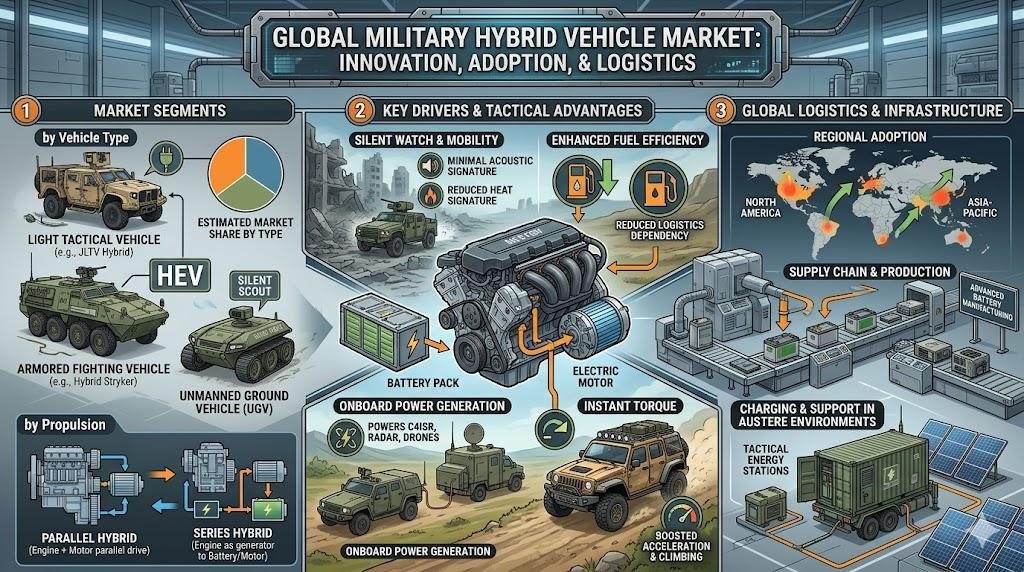
The defense sector is entering a pivotal phase of modernization, where the convergence of tactical performance and environmental sustainability is redefining vehicle procurement. As global defense agencies prioritize operational efficiency and reduced logistical burdens, the transition from traditional internal combustion engines to hybrid propulsion systems has accelerated.The Military Hybrid Vehicle Market is anticipated to expand at a CAGR of 14.5% from 2026 to 2034. This significant growth reflects an industry wide shift toward electrification, aimed at enhancing stealth capabilities through silent watch and silent drive features while simultaneously addressing the high costs and risks associated with fuel supply chains in contested environments.
Strategic Drivers and Market Dynamics
The primary impetus for the adoption of hybrid technology in defense stems from the need for increased energy on board to power sophisticated electronic warfare systems, advanced communication suites, and high energy laser weapons. Traditional vehicle architectures often struggle to provide the necessary electrical throughput without compromising mobility. Hybrid electric vehicles (HEVs) solve this by integrating high capacity battery storage with efficient internal combustion engines. Furthermore, the rising global defense expenditure, led by the US and China, supports the acquisition of enhanced technologies.Modernization programs are increasingly replacing outdated, single purpose fleets with multi role platforms that offer better fuel economy and a reduced thermal signature, which is critical for evading modern detection systems.
Acceleration of the US Military Hybrid Vehicle Market
Within North America, the US military hybrid vehicle market is at the forefront of this technological revolution, driven by stringent Department of Defense (DoD) initiatives to reduce fossil fuel dependency and increase the resilience of tactical units. The focus in the United States has shifted toward developing robust, military grade hybrid systems that can withstand extreme temperatures and rugged terrains while providing a significant leap in power density. These advancements are not merely about sustainability; they provide a decisive tactical advantage by allowing vehicles to operate for extended periods in "silent mode," reducing both noise and heat signatures. The integration of high capacity lithium ion batteries and regenerative braking systems into armored personnel carriers and light tactical vehicles is a testament to the US military’s commitment to maintaining a technological edge on the modern battlefield.
Technological Innovations in Propulsion and Energy Storage
Innovation in the military hybrid space is heavily focused on battery technology and power management systems.Defense contractors are investing in wide bandgap semiconductors and modular power architectures to handle the increased electrical loads of modern combat systems. The development of parallel and series parallel hybrid powertrains allows for flexible power distribution, ensuring that a vehicle can continue its mission even if one propulsion component is compromised. Additionally, advancements in energy management software enable autonomous and remotely operated vehicles to optimize power usage based on mission profiles, whether they require high speed transit or low speed, high endurance surveillance operations.
Download Sample PDF:https://www.theinsightpartners.com/sample/TIPRE00017702
Key Players in the Military Hybrid Vehicle Industry
The competitive landscape of the market involves established defense giants and specialized technology firms collaborating to deliver cutting edge propulsion solutions.These entities are securing significant contracts to supply the next generation of electrified combat and logistics platforms. Key participants in the industry include:
-
BAE Systems
-
General Dynamics Land Systems
-
Leonardo S.p.A.
-
Lockheed Martin Corporation
-
Oshkosh Defense, LLC
-
Rheinmetall AG
-
Textron Inc.
-
Wrightspeed
-
Allison Transmission
-
Alke s.r.l.
Challenges and Infrastructure Requirements
Despite the clear operational benefits, the market faces hurdles related to high initial acquisition costs and the complexity of field maintenance.The total cost of ownership for hybrid systems is currently higher than traditional vehicles due to the specialized nature of high capacity batteries and electric drivetrains.Moreover, the integration of these vehicles into existing military infrastructure requires significant investment in mobile charging stations and technical training for maintenance personnel. However, as the technology matures and manufacturing scales, these costs are expected to decrease, further driving the adoption of hybrid platforms across a broader range of military applications, from logistics trucks to main battle tanks.
Future Outlook
The trajectory of the military hybrid sector is inextricably linked to the broader trends of autonomy and digitalization. As the industry moves toward 2034, we can expect the emergence of fully autonomous hybrid platforms that utilize AI to manage energy consumption and navigate complex environments without human intervention. The push for carbon neutral defense operations will likely lead to the integration of renewable energy sources, such as portable solar arrays, to recharge vehicle batteries in remote locations. This evolution will not only reduce the environmental footprint of military activities but will also create a more agile and self sustaining force capable of operating in the most demanding global theaters.
Related Reports:
Space Sensors and Actuators Market
About Us
The Insight Partners is a leading global market research and consulting firm specializing in delivering actionable insights across various industries. Our research reports combine extensive primary and secondary research to provide accurate market intelligence, helping businesses make informed strategic decisions. The company provides detailed analysis on emerging technologies, market trends, competitive landscapes, and growth opportunities across sectors including technology, healthcare, manufacturing, and energy.
Contact Us
The Insight Partners
Phone: +1-646-491-9876
Email: sales@theinsightpartners.com
Website: https://www.theinsightpartners.com

 English
 French
 Portuguese
 Russian