

Electronic Logging Device Market Set to Reach USD 24.5 Billion by 2035 as Fleet Digitization Accelerates Worldwide
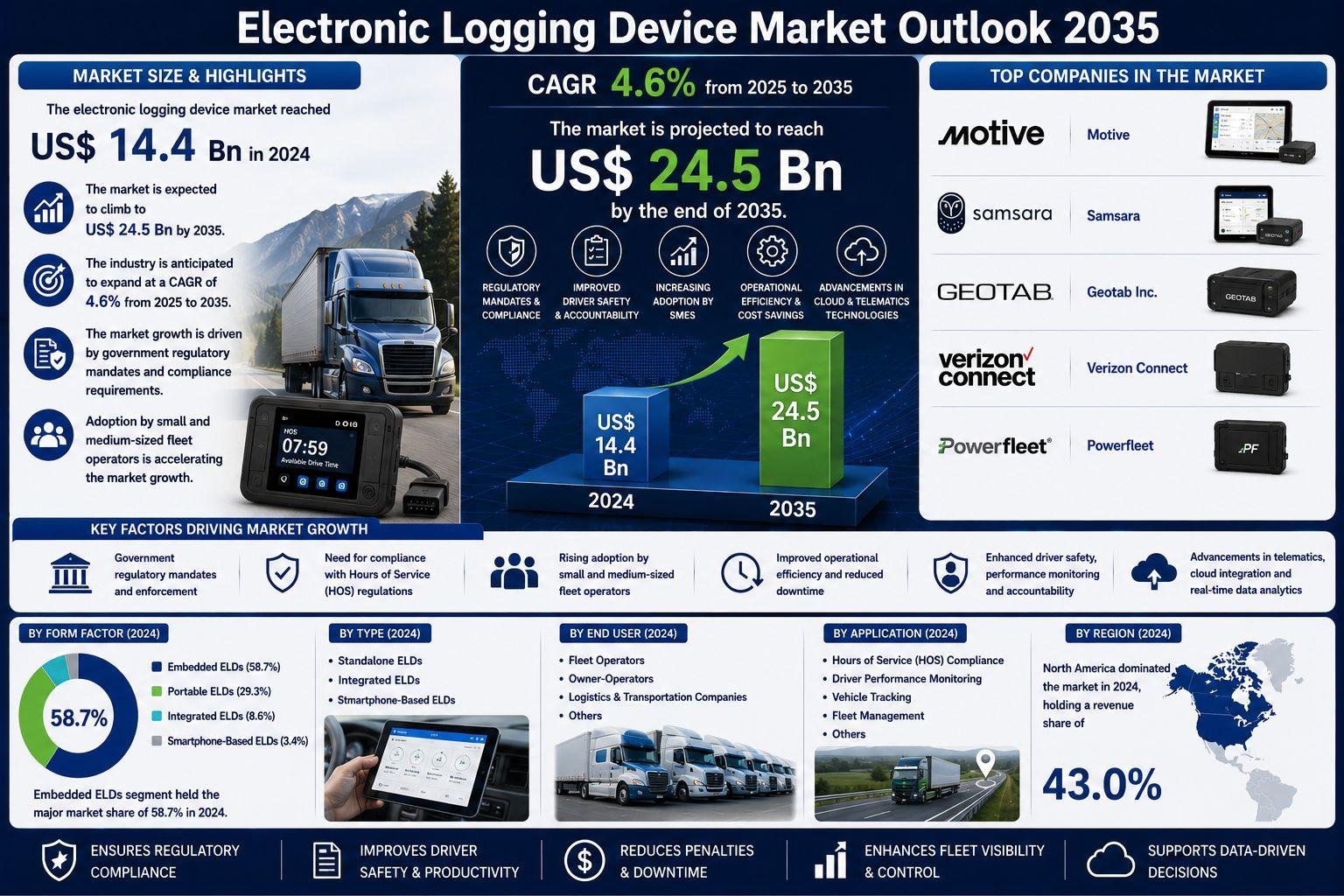
The global Electronic Logging Device (ELD) market is experiencing steady growth as transportation companies increasingly adopt digital solutions to improve regulatory compliance, fleet safety, and operational efficiency. Valued at US$ 14.4 Billion in 2024, the market is projected to reach US$ 24.5 Billion by 2035, expanding at a CAGR of 4.6% from 2025 to 2035.
The growing emphasis on road safety, stricter government regulations regarding driver hours, and the rising adoption of fleet management technologies are key factors supporting market expansion. Electronic logging devices have evolved from simple compliance tools into comprehensive fleet intelligence platforms capable of providing real-time insights into vehicle performance, driver behavior, and logistics operations.
Growing Importance of Electronic Logging Devices in Modern Transportation
Electronic Logging Devices are digital systems designed to automatically record a driver's Hours of Service (HOS), vehicle movement, engine operation, distance traveled, and location data. These devices replace traditional paper logbooks, helping fleet operators maintain accurate records while reducing administrative burdens and human errors.
The transportation and logistics industry has undergone significant digital transformation in recent years. Fleet operators are increasingly relying on telematics, cloud-based software, and connected vehicle technologies to streamline operations. As a result, ELDs have become a critical component of fleet management strategies, enabling businesses to improve transparency, optimize routes, reduce fuel consumption, and enhance driver safety.
Modern ELD platforms now integrate seamlessly with telematics systems, offering advanced functionalities such as predictive maintenance, driver performance monitoring, route optimization, and real-time vehicle tracking.
Government Regulations Driving Market Growth
One of the primary drivers of the Electronic Logging Device market is the implementation of government mandates and compliance requirements across major transportation markets.
Countries such as the United States and Canada have introduced regulations requiring commercial vehicle operators to use ELDs to accurately record driver working hours. Similar initiatives are emerging across Europe and other regions as governments seek to improve road safety and reduce accidents caused by driver fatigue.
These regulations are designed to ensure compliance with labor standards, promote fair working conditions, and increase accountability within the transportation industry. By automating recordkeeping and reducing opportunities for logbook manipulation, ELDs help regulatory authorities enforce safety standards more effectively.
As compliance requirements continue to evolve globally, fleet operators are investing in advanced ELD solutions to avoid penalties, improve reporting accuracy, and maintain regulatory compliance.
Rising Adoption Among Small and Medium-Sized Fleet Operators
While large transportation companies were among the earliest adopters of ELD technology, small and medium-sized fleet operators are now emerging as a major growth segment within the market.
Historically, the cost of ELD implementation, hardware installation, and software integration limited adoption among smaller businesses. However, advances in cloud computing, mobile applications, and affordable subscription-based services have significantly lowered barriers to entry.
Today, small and medium-sized enterprises (SMEs) recognize the operational advantages offered by ELD systems. Beyond regulatory compliance, these solutions provide valuable data on vehicle utilization, fuel efficiency, driver performance, and route planning.
Scalable cloud-based platforms allow smaller fleets to access sophisticated fleet management capabilities without requiring significant IT investments. This democratization of technology is accelerating ELD adoption across transportation businesses of all sizes and contributing substantially to overall market growth.
Embedded ELDs Lead the Market
Based on form factor, the Embedded ELDs segment accounted for the largest share of the global market, capturing 58.7% of total revenue in 2024.
Embedded ELDs are permanently integrated into a vehicle's onboard systems and communicate directly with the Engine Control Unit (ECU). This direct connection ensures highly accurate data collection related to engine performance, vehicle movement, driving hours, and operational metrics.
The reliability and regulatory compliance offered by embedded systems make them particularly attractive to commercial fleet operators. These solutions reduce the risk of data tampering, improve reporting accuracy, and provide stable long-term performance.
As governments continue tightening compliance standards, demand for embedded ELD solutions is expected to remain strong throughout the forecast period.
North America Maintains Market Leadership
North America dominated the global Electronic Logging Device market in 2024, accounting for 43.0% of total revenue.
The region's leadership is largely attributed to its robust regulatory framework, advanced transportation infrastructure, and widespread adoption of telematics technologies. The United States ELD mandate and Canada's nationwide ELD regulations have significantly accelerated market penetration across commercial vehicle fleets.
Additionally, North America is home to a large concentration of logistics providers, trucking companies, and commercial fleet operators that actively invest in digital fleet management solutions. The integration of ELDs with telematics, safety monitoring systems, and fleet optimization platforms has become standard practice across many transportation organizations.
The region's mature technology ecosystem and strong regulatory support are expected to sustain market growth over the coming years.
Competitive Landscape and Industry Developments
The Electronic Logging Device market is characterized by intense competition and continuous technological innovation. Leading companies are focusing on expanding product portfolios, enhancing telematics capabilities, and strengthening their global presence through strategic acquisitions and partnerships.
Major players operating in the market include Motive, Samsara, Geotab Inc., Verizon Connect, Teletrac Navman, Garmin ELD, KeepTruckin, Omnitracs LLC, GPS Trackit ELD, Rand McNally, Gorilla Safety ELD, BigRoad DashLink ELD, Azuga Inc., and Powerfleet.
Recent industry developments highlight ongoing market consolidation. In April 2024, Powerfleet acquired MiX Telematics, strengthening its global telematics and fleet management capabilities. In September 2025, Geotab acquired Verizon Connect's commercial telematics operations across multiple European countries and Australia, expanding its reach among small and mid-sized fleet operators.
Future Outlook
The future of the Electronic Logging Device market remains promising as transportation companies continue embracing digital transformation initiatives. Growing regulatory requirements, increasing demand for fleet visibility, and advancements in connected vehicle technologies will continue driving market expansion.
As ELD platforms evolve into comprehensive fleet intelligence solutions, organizations will increasingly leverage real-time analytics, telematics integration, and cloud-based technologies to improve efficiency, safety, and profitability. With expanding adoption across fleets of all sizes, the global Electronic Logging Device market is well-positioned for sustained growth through 2035.
