

Anti-Infective Drugs Market to Reach USD 187.5 Billion by 2035 as Rising Infectious Disease Burden and Antimicrobial Innovation Drive Global Growth
The global Anti-Infective Drugs Market continues to play a critical role in modern healthcare by providing life-saving therapies against bacterial, viral, fungal, and parasitic infections. Increasing prevalence of infectious diseases, rising antimicrobial resistance, growing elderly population, and continuous pharmaceutical innovation are accelerating the demand for advanced anti-infective therapies worldwide.
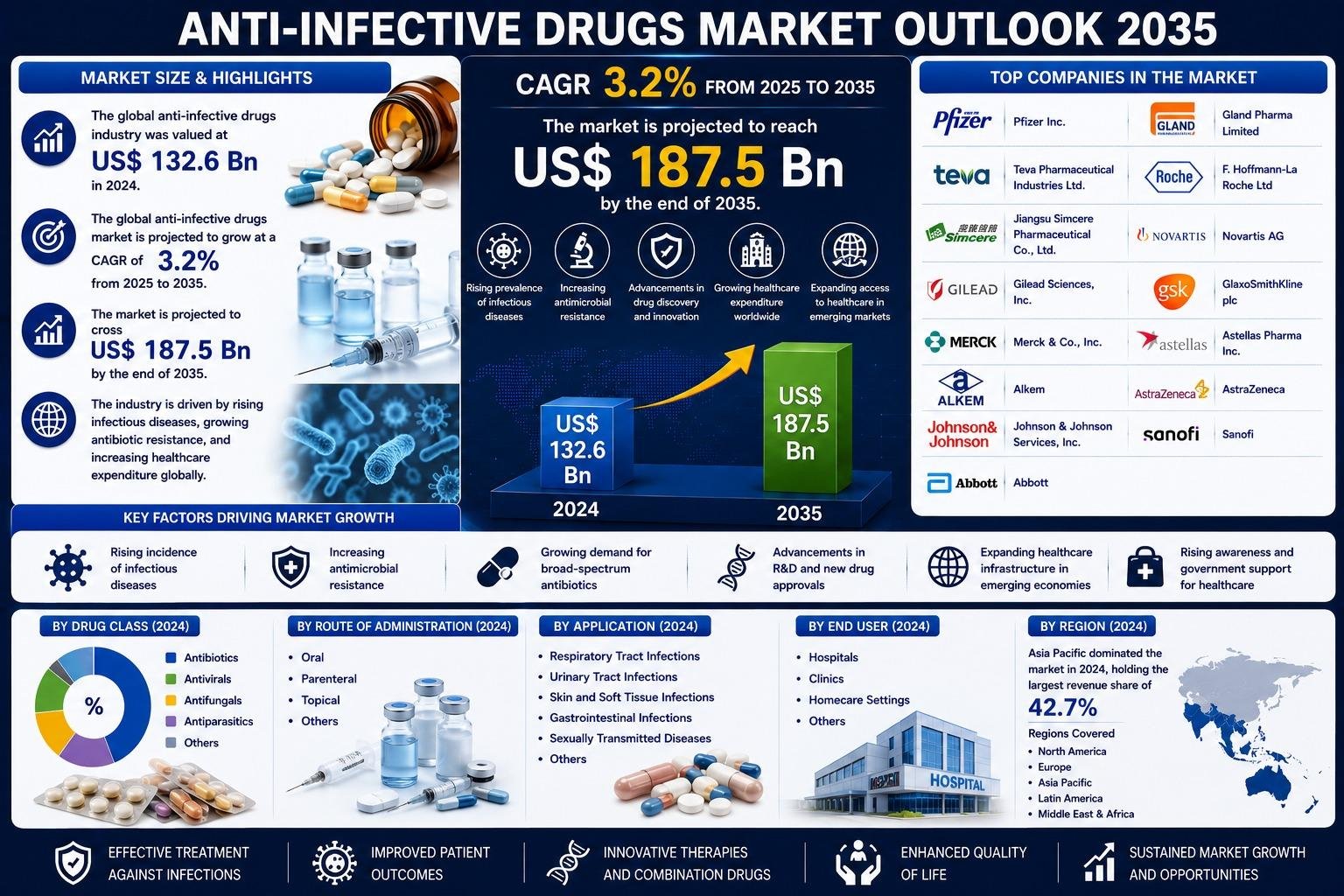
According to the latest market analysis, the global Anti-Infective Drugs Market was valued at US$ 132.6 Billion in 2024 and is projected to reach US$ 187.5 Billion by 2035, expanding at a CAGR of 3.2% from 2025 to 2035.
The market is benefiting from significant investments in research and development, rapid advancements in antimicrobial drug discovery, increasing government initiatives to improve access to essential medicines, and the integration of artificial intelligence into pharmaceutical research. Growing demand for novel antibiotics, antivirals, antifungals, and targeted immunotherapies is expected to support sustained market expansion throughout the forecast period.
Rising Prevalence of Infectious Diseases Drives Market Growth
The increasing global burden of infectious diseases remains one of the strongest drivers of the Anti-Infective Drugs Market.
Rapid urbanization, globalization, population growth, climate change, antimicrobial resistance, and increased international travel have significantly accelerated the spread of infectious diseases across developed and developing nations.
Respiratory tract infections, sepsis, tuberculosis, urinary tract infections, bloodstream infections, viral hepatitis, HIV, influenza, fungal infections, and emerging viral outbreaks continue to place substantial pressure on healthcare systems worldwide.
Healthcare providers increasingly rely on anti-infective drugs to rapidly control disease progression, reduce mortality, shorten hospital stays, and prevent severe complications.
The continued emergence of novel pathogens and re-emerging infectious diseases further reinforces the need for effective anti-infective therapies capable of addressing evolving public health challenges.
As governments continue strengthening infectious disease preparedness and outbreak response capabilities, demand for innovative anti-infective medications is expected to remain strong.
Growing Antimicrobial Resistance Accelerates Drug Development
Antimicrobial resistance (AMR) has become one of the most significant global healthcare challenges, creating urgent demand for next-generation anti-infective therapies.
The inappropriate use of antibiotics, incomplete treatment courses, excessive prescriptions, and misuse in agriculture have contributed to the emergence of drug-resistant bacterial strains.
Many previously effective antibiotics now demonstrate reduced clinical efficacy, increasing the need for innovative antimicrobial agents with novel mechanisms of action.
Pharmaceutical companies are investing heavily in developing advanced antibiotics, combination therapies, antimicrobial peptides, bacteriophage therapies, immune-modulating drugs, and targeted delivery technologies to overcome resistance.
Research efforts also focus on developing narrow-spectrum antibiotics capable of selectively targeting pathogens while preserving beneficial microbiota, thereby reducing resistance development.
As antimicrobial resistance continues threatening global healthcare systems, sustained investment in anti-infective drug innovation will remain essential for future market growth.
Expanding Elderly Population Supports Market Expansion
The rapidly aging global population is creating additional demand for anti-infective medications.
Older adults generally experience weakened immune function, making them significantly more susceptible to bacterial, viral, fungal, and opportunistic infections.
Healthcare-associated infections remain particularly common among elderly patients residing in hospitals, rehabilitation centers, and long-term care facilities.
Respiratory infections, urinary tract infections, bloodstream infections, skin infections, and post-operative complications frequently require prolonged anti-infective treatment in aging populations.
Furthermore, elderly patients undergoing chemotherapy, organ transplantation, or major surgical procedures often receive prophylactic anti-infective therapies to prevent severe infections.
Pharmaceutical manufacturers increasingly develop long-acting injectables, simplified oral dosage forms, fixed-dose combinations, and patient-friendly formulations specifically designed to improve treatment adherence among older adults.
As global life expectancy continues increasing, elderly patients will remain a major contributor to future market demand.
Artificial Intelligence Transforms Anti-Infective Drug Discovery
Technological innovation is significantly reshaping pharmaceutical research within the Anti-Infective Drugs Market.
Artificial intelligence (AI), machine learning, computational biology, and advanced bioinformatics are enabling researchers to accelerate drug discovery while reducing development costs.
AI-powered platforms rapidly analyze enormous biological datasets to identify promising drug candidates, predict molecular interactions, optimize clinical trial designs, and improve treatment selection.
Machine learning algorithms also help researchers identify potential resistance mechanisms before new drugs reach commercialization.
These technological advances substantially reduce research timelines while improving the probability of successful drug development.
Beyond discovery, digital health technologies facilitate remote patient monitoring, real-world evidence collection, clinical trial optimization, and treatment adherence, further strengthening innovation across the anti-infective pharmaceutical landscape.
Public Health Initiatives Improve Global Access
Government organizations, international healthcare agencies, and non-governmental organizations continue supporting global access to essential anti-infective medicines.
Programs targeting tuberculosis, HIV/AIDS, hepatitis, malaria, neglected tropical diseases, and antimicrobial resistance have increased funding for research, procurement, and treatment access across low- and middle-income countries.
Public-private partnerships encourage pharmaceutical innovation while expanding affordable treatment availability in underserved populations.
Vaccination campaigns combined with appropriate anti-infective therapies continue reducing disease burden and improving healthcare outcomes worldwide.
Growing investments in healthcare infrastructure, disease surveillance, antimicrobial stewardship, and infection prevention further strengthen long-term demand for anti-infective medications.
Antiviral Drugs Lead the Anti-Infective Drugs Market
Based on drug class, Antiviral Drugs represent the leading segment within the global Anti-Infective Drugs Market.
The widespread prevalence of HIV, hepatitis B, hepatitis C, influenza, respiratory viral infections, and emerging viral outbreaks continues driving sustained demand for advanced antiviral therapies.
Continuous pharmaceutical innovation has produced highly effective next-generation antiviral agents offering improved efficacy, enhanced safety profiles, simplified dosing schedules, and better patient adherence.
Preventive healthcare strategies, increasing vaccination programs, and government preparedness against viral epidemics have further strengthened antiviral adoption.
Growing research into long-acting antiviral therapies, combination regimens, RNA-based therapeutics, and personalized treatment approaches continues expanding opportunities within this segment.
As viral infections remain major global public health concerns, antiviral drugs are expected to maintain their dominant market position throughout the forecast period.
North America Dominates the Global Anti-Infective Drugs Market
North America accounted for the largest share of the Anti-Infective Drugs Market in 2024.
The region benefits from advanced healthcare infrastructure, high pharmaceutical research investments, favorable regulatory frameworks, extensive healthcare spending, and rapid adoption of innovative anti-infective therapies.
The United States remains one of the world's leading pharmaceutical innovation centers, with continuous development of novel antibiotics, antivirals, antifungals, and biologic therapies.
Healthcare providers throughout North America maintain strong antimicrobial stewardship programs while actively addressing healthcare-associated infections and antimicrobial resistance.
Regulatory agencies continue supporting accelerated approvals for innovative therapies targeting multidrug-resistant pathogens and emerging infectious diseases.
Meanwhile, Europe maintains a significant market position through strong public healthcare systems and research funding, while Asia Pacific is expected to witness the fastest future growth due to expanding healthcare infrastructure, increasing infectious disease burden, rising pharmaceutical manufacturing capacity, and growing government healthcare investments.
Competitive Landscape
The Anti-Infective Drugs Market remains highly competitive, with global pharmaceutical companies continuously investing in drug discovery, manufacturing expansion, strategic collaborations, and advanced therapeutic technologies.
Major companies operating in the market include Pfizer Inc., Gland Pharma Limited, Teva Pharmaceutical Industries Ltd., F. Hoffmann-La Roche Ltd., Jiangsu Simcere Pharmaceutical Co., Ltd., Novartis AG, Gilead Sciences, Inc., GlaxoSmithKline plc, Merck & Co., Inc., Astellas Pharma Inc., Alkem, AstraZeneca, Johnson & Johnson Services, Inc., Sanofi, and Abbott.
These companies continue strengthening their market positions through extensive research and development, portfolio diversification, regulatory approvals, geographic expansion, and strategic licensing agreements.
Many organizations are also incorporating artificial intelligence into drug discovery while expanding manufacturing capabilities to address increasing global demand.
Recent Industry Developments
Several important developments continue driving innovation within the Anti-Infective Drugs Market.
In July 2025, Merck & Co., Inc. announced that the U.S. Food and Drug Administration accepted the New Drug Application for doravirine/islatravine (DOR/ISL), an investigational oral two-drug regimen designed for virologically suppressed adults living with HIV-1.
In April 2024, Pfizer Inc. received approval from the European Commission for EMBLAVEO (aztreonam-avibactam) for treating complicated intra-abdominal infections, hospital-acquired pneumonia, ventilator-associated pneumonia, complicated urinary tract infections, pyelonephritis, and severe infections caused by multidrug-resistant Gram-negative bacteria.
These regulatory approvals demonstrate the pharmaceutical industry's continued commitment to addressing growing antimicrobial resistance and expanding treatment options for complex infectious diseases.
Future Outlook
The outlook for the global Anti-Infective Drugs Market remains positive as infectious diseases continue representing one of the world's most significant healthcare challenges.
Growing antimicrobial resistance, aging populations, expanding global healthcare access, rising pharmaceutical innovation, and increasing investments in artificial intelligence-driven drug discovery will continue supporting long-term market growth.
Emerging technologies including targeted antimicrobial therapies, microbiome-based therapeutics, immune-modulating treatments, precision medicine, and long-acting anti-infective formulations are expected to redefine infectious disease management during the coming decade.
As governments, healthcare providers, and pharmaceutical companies continue prioritizing infection prevention, antimicrobial stewardship, and rapid therapeutic innovation, the Anti-Infective Drugs Market is expected to maintain steady global expansion through 2035 while playing a pivotal role in improving patient outcomes and strengthening global public health.
