

Reducing Documentation Gaps in Behavioral Health and Rehab Facilities
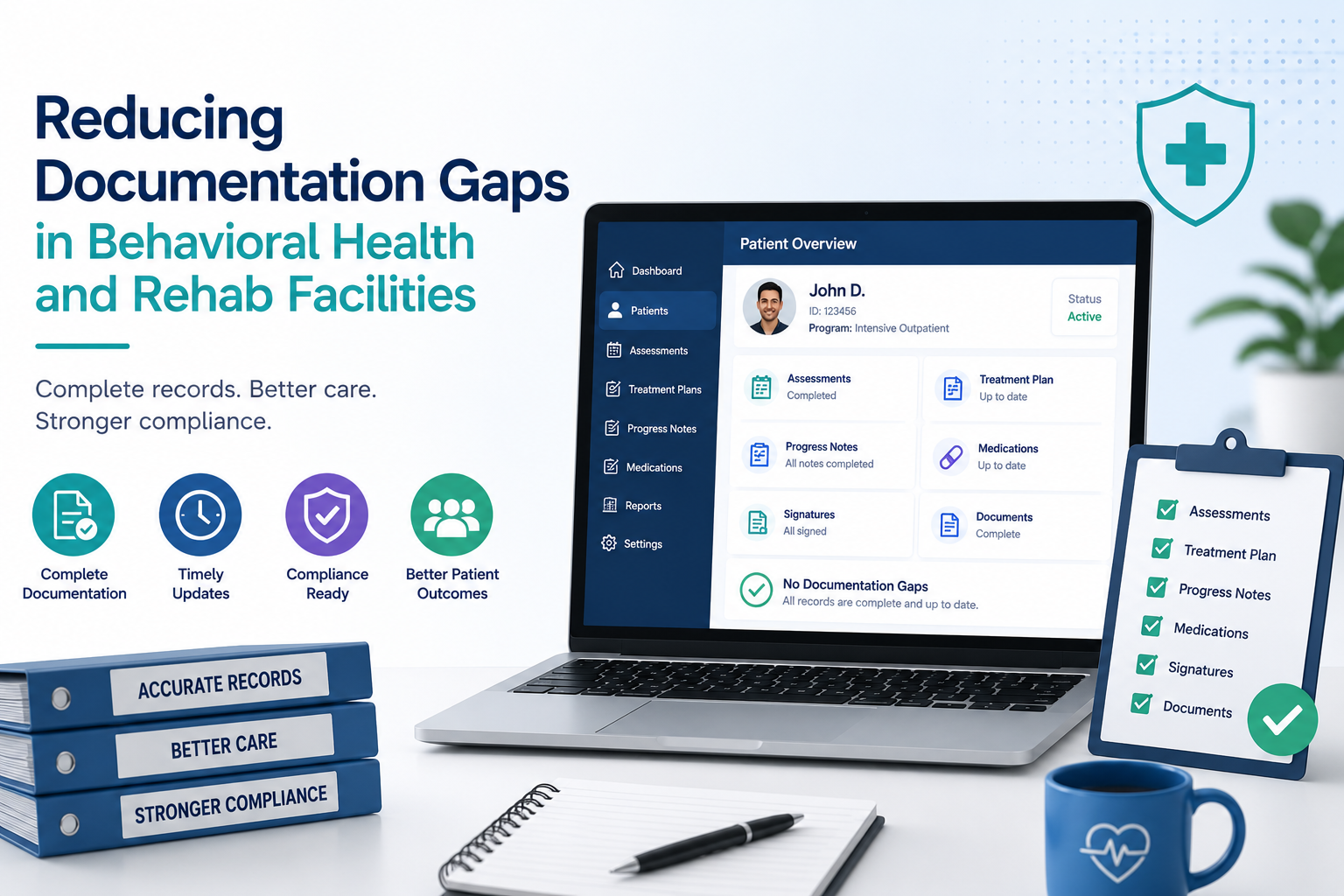
Accurate documentation is essential in behavioral health and addiction treatment. It supports clinical decisions, care coordination, billing, compliance, audits, treatment planning, and continuity across different levels of care.
Yet documentation gaps remain a common operational challenge for many facilities. Progress notes may be completed late, treatment plans may not reflect recent changes, required signatures may be missing, and important patient information may remain scattered across paper forms, spreadsheets, emails, and disconnected systems.
These gaps create more than an administrative inconvenience. They can affect communication between providers, delay claims, weaken audit readiness, and make it difficult to understand a patient’s current treatment status.
Behavioral health and rehab facilities can reduce documentation gaps by standardizing workflows, connecting clinical records, improving accountability, and introducing technology that supports timely and accurate charting.
Identify Where Documentation Gaps Occur
The first step is understanding where information is most frequently lost, delayed, or recorded inconsistently.
Common documentation gaps include:
- Incomplete intake forms
- Missing assessment details
- Delayed progress notes
- Unsigned records
- Outdated treatment plans
- Incomplete group therapy notes
- Missing medication updates
- Unrecorded patient consent
- Inconsistent service dates
- Incomplete discharge summaries
- Missing aftercare follow-ups
Facilities should review the complete patient journey, from intake through discharge, to identify where staff depend on manual handoffs or duplicate entry.
A workflow review often reveals that documentation problems are caused by inefficient processes rather than individual performance.
Standardize Clinical Documentation
When clinicians use different note formats and terminology, records become difficult to review and compare.
Facilities should establish clear documentation standards for:
- Patient assessments
- Individual therapy
- Group therapy
- Treatment planning
- Medication management
- Case management
- Risk evaluations
- Discharge planning
- Aftercare
Each standard should define which fields are required, who is responsible, when the record must be completed, and whether supervisory approval is needed.
Structured templates can help staff capture the necessary information consistently while still allowing room for professional observations.
Connect Assessments With Treatment Plans
Documentation gaps often appear when assessments and treatment plans operate as separate processes.
Clinicians may document patient risks and needs during assessment, but those findings may not be carried forward into the active treatment plan.
A connected workflow can convert assessment findings into treatment problems, goals, interventions, responsibilities, and review dates.
For example, a high relapse risk identified during assessment can lead to a relapse-prevention objective. Housing instability can generate a case-management task, while medication concerns can create a physician follow-up requirement.
This improves continuity and reduces the risk that important assessment findings are overlooked.
Link Progress Notes to Treatment Goals
Progress notes should clearly explain how the service delivered supports the patient’s treatment plan.
When notes do not reference active goals, it can be difficult to understand the clinical purpose of a session or evaluate whether treatment is progressing.
A structured progress note may include:
- Treatment objective addressed
- Intervention provided
- Patient response
- Clinical observations
- Progress toward the goal
- Current risks
- Recommended follow-up
Digital workflows can allow clinicians to select the relevant treatment objective directly within the note.
This creates a stronger connection between planning, treatment delivery, and outcome monitoring.
Support Timely Documentation
The longer clinicians wait to complete notes, the greater the risk of missing important details.
Delayed documentation can also affect care coordination, billing, compliance reviews, and treatment-plan updates.
Facilities can support timely completion through:
- Simplified templates
- Mobile or tablet access
- Automated reminders
- Protected documentation time
- Clear completion deadlines
- Draft and review workflows
- Supervisor dashboards
The goal should be to make timely documentation practical within the clinical workload.
If records are frequently overdue, management should determine whether the issue is related to staffing, template complexity, training, or system usability.
Improve Group Therapy Documentation
Group therapy creates a unique documentation challenge because one session may involve several patients.
Without a dedicated workflow, counselors may need to repeat the same topic, intervention, and session details across multiple records.
A group-documentation workflow can allow common session information to be entered once. The counselor can then add individualized observations for each participant.
Patient-specific details may include:
- Attendance
- Level of participation
- Response to the topic
- Behavioral observations
- Progress toward goals
- Need for follow-up
This reduces repetitive entry while maintaining clinically meaningful documentation for every patient.
Connect Scheduling With Clinical Records
Appointments and documentation should be linked.
When an individual or group session is completed, the system can automatically create the appropriate note task.
This connection helps facilities identify:
- Completed appointments without notes
- Notes without matching appointments
- Cancelled services documented as completed
- Missing group attendance
- Incorrect service dates
- Duplicate records
- Overdue documentation
Linking scheduling and charting improves record accuracy and gives supervisors better visibility into pending work.
Use Required Fields and Validation Checks
Validation checks can help identify missing information before a record is finalized.
The system may flag:
- Missing signatures
- Empty required fields
- Incomplete treatment-plan references
- Invalid service dates
- Duplicate notes
- Missing attendance
- Inconsistent provider details
- Overdue reviews
- Missing consent
These controls reduce the need for administrators to manually review every record.
However, validation should be carefully designed. Too many irrelevant alerts can create frustration and cause staff to ignore important warnings.
Strengthen Signature and Approval Workflows
Missing signatures and approvals are common documentation gaps.
Facilities should clearly define which records require:
- Clinician signatures
- Supervisor approval
- Physician review
- Patient acknowledgment
- Multidisciplinary review
Digital workflows can route documents automatically to the appropriate reviewer.
The system can track whether the record is pending, approved, returned for correction, or completed.
Electronic signatures and approval histories create greater accountability and reduce manual follow-up.
Coordinate Medication Documentation
Medication information can become fragmented when prescriptions, adherence notes, side effects, and therapy observations are recorded in different places.
A connected record should include:
- Current medications
- Dosage
- Administration history
- Refill status
- Adherence
- Side effects
- Allergies
- Missed appointments
- Clinical follow-ups
Authorized medical and behavioral health professionals should be able to review the latest relevant information.
This is especially important in medication-assisted treatment, where medication management and counseling should remain coordinated.
Improve Clinical Handoffs
Documentation gaps often become visible during shift changes, provider reassignments, or transitions between programs.
The receiving provider needs an accurate summary of:
- Current treatment goals
- Recent clinical updates
- Active risks
- Medication status
- Progress
- Pending tasks
- Upcoming appointments
- Recommended next steps
Structured handoff workflows reduce reliance on verbal updates and handwritten notes.
They also help maintain continuity when a provider is unavailable or a patient moves to another level of care.
Connect Clinical Documentation With Billing
Billing delays frequently occur because clinical records are incomplete.
Common issues include:
- Missing progress notes
- Unsigned records
- Outdated treatment plans
- Incorrect service dates
- Incomplete attendance
- Missing authorization information
- Coding inconsistencies
Connected workflows can help billing teams verify whether documentation is complete before a claim is submitted.
Clinicians can receive alerts when a note requires correction, reducing repeated emails and phone calls between departments.
Clinical records should always support patient care first, but complete documentation also improves reimbursement readiness.
Strengthen Compliance and Audit Readiness
Behavioral health and addiction treatment records contain highly sensitive information.
Facilities need clear controls around access, consent, documentation changes, and record sharing.
Important capabilities include:
- Role-based access
- Electronic signatures
- Audit trails
- Consent management
- Encryption
- Amendment histories
- Access monitoring
- Secure record exchange
Audit trails should show who created, reviewed, accessed, or changed a record.
This supports accountability and makes internal and external audits easier to manage.
Conduct Regular Documentation Audits
Routine audits help facilities identify recurring gaps and workflow problems.
Reviews may evaluate:
- Note completeness
- Documentation timeliness
- Missing signatures
- Treatment-plan alignment
- Consent records
- Medication documentation
- Billing readiness
- Discharge summaries
- Aftercare records
Audit findings should be used to improve systems, templates, training, and staffing.
The purpose should be continuous improvement rather than punishment.
Train Staff on Practical Documentation
Technology alone cannot eliminate documentation gaps.
Staff need practical training that explains both what to document and why it matters.
Training topics may include:
- Writing clear progress notes
- Connecting notes to treatment goals
- Documenting patient response
- Recording group participation
- Completing electronic signatures
- Making appropriate amendments
- Protecting patient confidentiality
- Documenting care transitions
Training should include realistic examples and periodic refreshers.
Monitor Documentation Performance
Facilities can use dashboards and reports to monitor documentation workflows.
Useful metrics may include:
- Percentage of notes completed on time
- Number of overdue records
- Missing signature rate
- Treatment-plan review completion
- Notes returned for correction
- Billing delays caused by documentation
- Group attendance completion
- Documentation workload by provider
These metrics should help identify where teams need better tools, training, staffing, or process changes.
Choose Technology That Reduces Gaps
The right platform should support structured assessments, treatment plans, progress notes, group charting, medication records, signatures, approvals, billing, and reporting.
It should also provide role-based access, audit histories, real-time updates, validation checks, and secure integrations.
Organizations evaluating a tailored solution can review our portfolio on substance abuse practice management software to see how structured clinical modules, role-based charting, progress monitoring, coding integration, and payer-connected workflows can be developed around real behavioral health operations.
Final Thoughts
Reducing documentation gaps requires more than asking clinicians to write better notes.
Facilities need connected workflows, practical templates, clear responsibilities, timely reminders, and reliable quality controls.
When assessments, treatment plans, progress notes, medications, billing, and care transitions operate within one coordinated process, records become more complete and useful.
Strong documentation supports safer care, better teamwork, cleaner billing, stronger compliance, and more consistent recovery outcomes.
 English