

Why Business Records Need a Reliable Long-Term Archiving Strategy
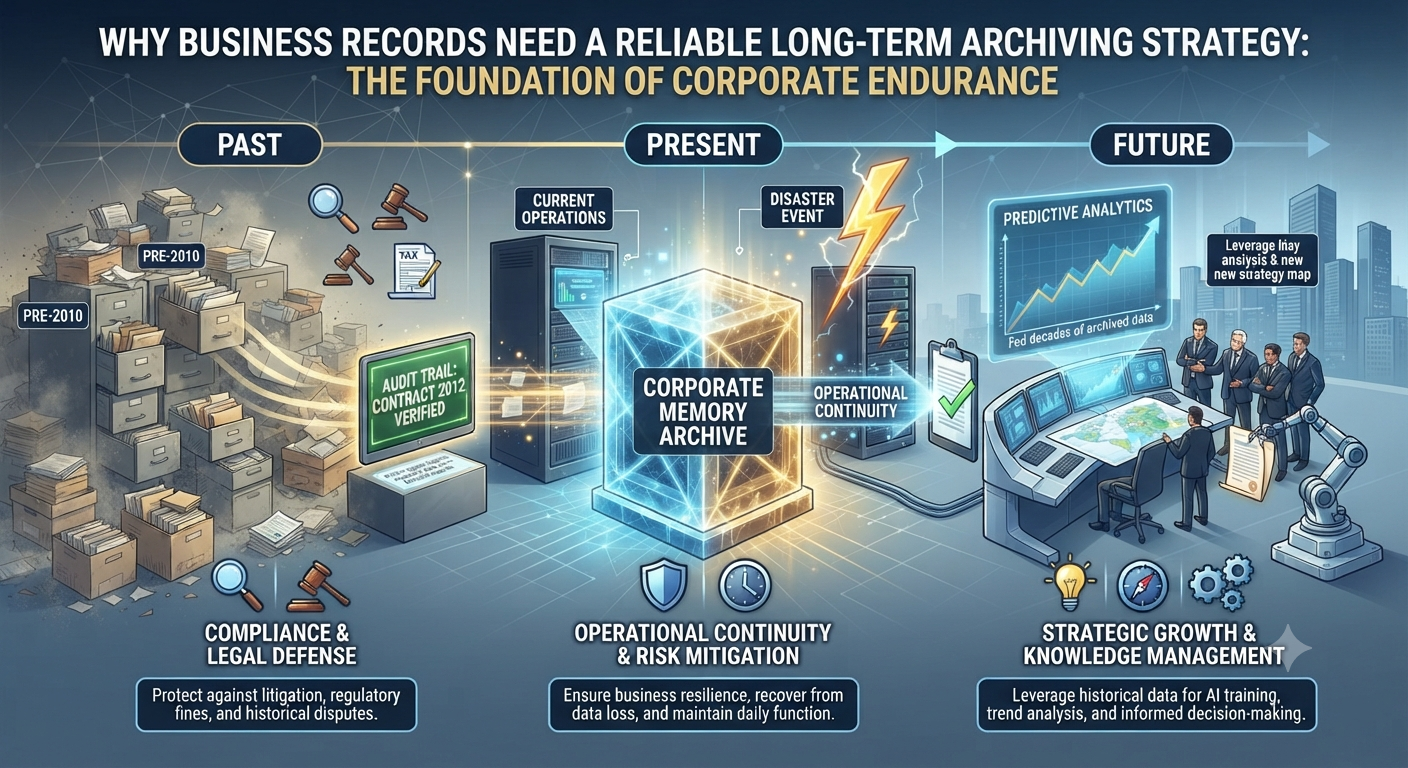
Business records often remain valuable long after the transaction, project, employee relationship, or software system connected to them has ended. Contracts may be needed during a dispute. Financial records may be requested during an audit. Signed documents may need to remain verifiable years after their certificates expire. Long Term Archiving provides a structured way to preserve this information so it remains accessible, understandable, secure, and trustworthy throughout its required lifecycle.
A reliable strategy does more than move old files into low-cost storage. It defines which records must be retained, how their integrity will be protected, who can access them, when they can be deleted, and how they will remain usable as technology changes.
Business Records Often Outlive Their Original Purpose
Most records are created to support an immediate business activity. An invoice supports a payment. A contract documents an agreement. An employee record supports a hiring or payroll process. A customer communication records an interaction.
Once that activity is complete, the record may no longer be used every day. However, its legal, operational, regulatory, or historical value may continue for many years.
Organizations may later need archived records to:
-
Respond to audits or regulatory requests
-
Investigate a complaint or suspected incident
-
Defend a contractual position
-
Confirm an earlier approval or decision
-
Support an insurance claim
-
Review a previous customer relationship
-
Verify an electronic signature
-
Complete a merger or acquisition
-
Respond to a data access request
-
Understand historical financial activity
Without a defined archiving strategy, these records can become scattered across shared drives, email accounts, local folders, legacy systems, and cloud platforms. The information may technically still exist, but locating and verifying it becomes increasingly difficult.
Long-Term Archiving Is Different From Ordinary Storage
Storage systems are generally designed to keep active files available. They help users save, edit, share, and collaborate on documents.
Archiving has a different objective. It preserves records that are no longer actively changing but must remain available for future reference, evidence, compliance, or historical use.
A reliable archive should preserve more than the visible contents of a document. It may also need to retain:
-
Original file formats
-
Document metadata
-
Creation and modification dates
-
Record ownership
-
Classification details
-
Electronic signatures and seals
-
Certificate validation information
-
Trusted timestamps
-
Access and activity logs
-
Retention instructions
-
Relationships between connected records
-
Evidence of migrations or format conversions
A file without its surrounding context can lose much of its meaning. For example, a contract may remain readable, but its evidential value can be weakened if the organization cannot show when it was signed, which version was approved, or whether the document changed afterward.
Long-Term Archiving protects the complete record rather than treating every file as an isolated object.
Reliable Archives Protect Record Integrity
Integrity refers to the ability to demonstrate that a record has remained complete and has not been altered improperly.
This is essential for records that may later be used as evidence. If a business cannot show how a document was captured, preserved, accessed, and transferred, questions may arise about its reliability.
A strong archiving environment can support integrity through several controls.
Controlled record ingestion
Records should enter the archive through documented processes. The system should verify that each file has been transferred correctly and capture relevant metadata at the point of ingestion.
Tamper-evident protection
Technical controls can help identify whether a file has changed after it entered the archive. Cryptographic checks, protected storage, and preservation logs can provide evidence of record consistency.
Detailed audit trails
Important actions should be recorded, including:
-
Record creation or ingestion
-
Access attempts
-
Metadata updates
-
Exports
-
Retention changes
-
Legal hold placement
-
Format conversions
-
Record deletion
An audit trail should clearly show what happened, when it happened, and which user or system performed the action.
Controlled version management
Where several versions of a document exist, the archive should distinguish drafts from final or authoritative records. Users should be able to identify which version carries the relevant legal or business status.
These controls do not automatically guarantee the legal admissibility of every archived record. Evidential value depends on the record, process, jurisdiction, and surrounding circumstances. However, reliable preservation practices help businesses demonstrate that records were managed consistently and responsibly.
Retention Rules Prevent Overkeeping and Premature Deletion
One of the most difficult archiving decisions is determining how long records should be kept.
Deleting a record too early may create legal, operational, or regulatory problems. Keeping every record forever can also create unnecessary risk.
Excessive retention may increase:
-
Storage and administration costs
-
Privacy exposure
-
Cybersecurity risk
-
Legal discovery workloads
-
Data access request complexity
-
The volume of outdated or duplicated information
A reliable Long-Term Archiving strategy assigns retention periods based on the nature and purpose of each record.
Retention decisions may consider:
-
Applicable laws and regulations
-
Contractual requirements
-
Industry obligations
-
Internal policies
-
Limitation periods
-
Customer relationships
-
Employment requirements
-
Tax and financial reporting needs
-
Historical or research value
-
Active disputes or investigations
Records should be classified consistently so that the correct retention rule can be applied automatically or through controlled workflows.
When a retention period expires, the organization should review whether the record is still subject to a legal hold, investigation, contractual obligation, or another legitimate reason for continued preservation.
Disposal should be approved, controlled, and documented. A deletion record can show what was removed, why it was removed, when the action occurred, and which policy authorized it.
Legal Holds Must Override Normal Disposal
Normal retention schedules cannot continue when records become relevant to litigation, an investigation, a regulatory inquiry, or another formal review.
A legal hold prevents selected information from being modified or deleted until the hold is released.
An effective legal hold process should allow organizations to:
-
Identify relevant record categories
-
Locate records across systems
-
Suspend scheduled disposal
-
Restrict unauthorized changes
-
Record when and why the hold was applied
-
Track the status of the matter
-
Release records through an authorized process
Legal holds should be linked with the archive rather than managed through informal emails or spreadsheets alone. If retention and legal hold processes are disconnected, records may be deleted accidentally even though they remain relevant to an active matter.
Records Must Remain Searchable and Understandable
Preserving a document is not enough if nobody can locate or interpret it later.
A reliable archive requires structured metadata and practical search capabilities. Users may need to retrieve records by:
-
Customer or supplier name
-
Employee number
-
Contract reference
-
Invoice number
-
Transaction date
-
Document category
-
Department
-
Project
-
Case number
-
Retention status
-
Application source
Search requirements should be defined before records are migrated. Otherwise, an organization may preserve a large amount of information without creating an efficient way to retrieve it.
Context is equally important. A database export containing thousands of unexplained fields may technically preserve the data, but it may not remain meaningful to future users.
The archive should retain relationships between records where necessary. An invoice may need to remain connected to its purchase order, approval history, attachments, and payment details. A customer case may include correspondence, forms, decisions, and supporting documents.
Long-term preservation must protect these connections rather than reducing a complete business record to a collection of unrelated files.
Electronic Signatures Require Special Preservation
Electronic signatures can become difficult to validate over long periods.
A signed document may rely on digital certificates, timestamps, cryptographic algorithms, validation services, and certificate revocation information. Some of these elements can expire or become outdated.
Saving only the visible PDF may not preserve all the evidence required to assess the signature later.
A signature preservation process may need to retain:
-
The original signed document
-
Signature certificates
-
Validation results
-
Revocation information
-
Trusted timestamps
-
Signature policy details
-
Evidence of later preservation actions
Long-term validation may also require new timestamps or other preservation measures before earlier cryptographic methods become unreliable.
Docbyte supports organizations that need to preserve signed records and the validation evidence surrounding them. This helps maintain access to the information required to evaluate the authenticity and integrity of electronic documents over time.
Format Obsolescence Can Make Archived Files Unusable
Digital files depend on software, operating systems, fonts, codecs, database structures, and technical standards.
A format that is widely supported today may become difficult to open in the future. Proprietary applications can be discontinued. Vendors may stop providing updates. Old databases may require infrastructure that is expensive or insecure to maintain.
A Long-Term Archiving strategy should therefore include format risk management.
This may involve:
-
Identifying formats with long-term accessibility risks
-
Retaining the original file
-
Converting records into stable preservation formats
-
Validating converted content
-
Recording every transformation
-
Preserving significant visual and functional characteristics
-
Reviewing archived formats periodically
A conversion should not be treated as a routine file export. The organization must verify that important content, metadata, signatures, attachments, layouts, and relationships have not been lost.
Any migration or conversion should create a documented preservation event so future users can understand what changed and why.
Archiving Enables Safe Application Retirement
Legacy applications are often kept running because they contain records that the organization may still need.
This can create significant cost and risk. Older systems may depend on unsupported software, outdated servers, specialist knowledge, and expensive licences. They may also lack modern security controls.
Archiving allows a business to separate retained information from the system that originally created it.
A structured application retirement process can include:
-
Reviewing the application and its data
-
Identifying records that must be retained
-
Removing duplicate or unnecessary information
-
Extracting records and relevant metadata
-
Preserving relationships between data and documents
-
Validating the completeness of the migration
-
Applying retention and access rules
-
Providing searchable access
-
Documenting the retirement process
-
Decommissioning the original system
This approach allows users to retrieve historical information without keeping the full legacy application operational.
Docbyte helps organizations archive data from retired systems while preserving searchability, context, governance, and long-term access. This can reduce technical dependency without sacrificing access to important business records.
Security Must Continue Throughout the Record Lifecycle
Archived information is sometimes treated as low risk because it is no longer active. In reality, historical records can contain valuable and sensitive data.
Archives may include:
-
Personal identification information
-
Financial details
-
Employment records
-
Health-related information
-
Commercial agreements
-
Legal communications
-
Intellectual property
-
Customer histories
-
Authentication data
Security controls should therefore apply throughout the entire retention period.
A controlled archive should support:
-
Role-based permissions
-
Least-privilege access
-
Multi-factor authentication
-
Encryption during transfer and storage
-
Segregation between departments or clients
-
Restrictions on downloads and exports
-
Regular access reviews
-
Security monitoring
-
Backup and recovery controls
-
Detailed audit logging
Organizations should also review privileged administrator access. An archive may have strong user-level restrictions but remain exposed if administrators can alter or delete records without adequate oversight.
Archives Must Support Privacy and Data Governance
Long-term preservation must be balanced with privacy and data protection obligations.
Businesses should not retain personal information without a defined purpose. They should understand what data is archived, why it is being kept, who can access it, and when it should be deleted.
Privacy controls may require organizations to:
-
Limit the collection of unnecessary personal information
-
Apply purpose-based retention periods
-
Restrict access to sensitive categories
-
Respond to lawful data subject requests
-
Document retention justifications
-
Remove data after its purpose expires
-
Preserve records when legal obligations require continued retention
Conflicts can arise between deletion requests and legal recordkeeping duties. These situations should be addressed through documented policies and input from legal, compliance, privacy, and records-management teams.
The archive should support these decisions rather than forcing every record into the same retention model.
Business Continuity Depends on Accessible Historical Information
Records support more than compliance. They also preserve organizational knowledge.
Employees leave. Business units merge. Suppliers change. Systems are replaced. Without reliable archiving, important decisions and historical information can disappear during these transitions.
Archived records can help organizations:
-
Reconstruct earlier decisions
-
Review previous contracts
-
Understand customer histories
-
Examine past projects
-
Validate product or service records
-
Respond to recurring operational problems
-
Support mergers and acquisitions
-
Transfer knowledge between teams
-
Avoid repeating previous mistakes
This institutional memory can become especially valuable during leadership changes, restructuring, or long-term projects.
How to Build a Reliable Archiving Strategy
A strong archiving programme begins with governance rather than software.
Organizations should first establish a clear understanding of their records and responsibilities.
Create a record inventory
Identify:
-
What records exist
-
Where they are stored
-
Which systems create them
-
Who owns them
-
What formats they use
-
Whether they contain sensitive information
-
How frequently they are accessed
Classify records by business value
Separate active information from records that need long-term preservation. Identify legal, regulatory, financial, operational, and historical record categories.
Define retention and disposal rules
Assign approved retention periods and document the reasons behind them. Define legal hold procedures and disposal approvals.
Establish access responsibilities
Determine which roles can view, manage, export, or delete archived records. Avoid providing broad access simply because information is old.
Plan for technology change
Identify vulnerable formats, unsupported systems, and applications approaching retirement. Establish migration and validation procedures before access becomes difficult.
Measure archive performance
Organizations should monitor indicators such as:
-
Retrieval time
-
Migration accuracy
-
Number of overdue disposal actions
-
Legal hold compliance
-
Access review completion
-
Search success rates
-
Volume of archived records
-
Format risk levels
-
Number of legacy systems retired
These measurements reveal whether the archive is delivering practical value rather than simply accumulating data.
Preserving Records as Long-Term Business Assets
A reliable Long-Term Archiving strategy protects records against more than accidental deletion. It addresses integrity, searchability, retention, security, privacy, signature validation, format obsolescence, and dependence on outdated applications.
The strongest strategies combine technology with clear governance. They define what must be preserved, why it matters, who is responsible, how access is controlled, and when disposal is appropriate.
Docbyte helps businesses preserve important records, protect signed digital evidence, retire legacy applications, and maintain controlled access to historical information. Organizations evaluating their current approach should begin by identifying records that are difficult to retrieve, dependent on outdated systems, or likely to remain important beyond the lifespan of their current technology.
