Aluminum sulfide is an important inorganic compound in chemistry, commonly used to understand basic concepts of ionic bonding and compound formation. The chemical formula for aluminum sulfide is Al₂S₃. This compound is formed when aluminum reacts with sulfur under controlled conditions. It is mainly studied in educational chemistry because it clearly demonstrates how metals and non-metals combine to form stable ionic compounds. Understanding its formula helps students learn about valency, charge balance, and chemical structure. Aluminum sulfide is not widely used in industry but plays an important role in chemistry learning and research.
Chemical Formula for Aluminum Sulfide
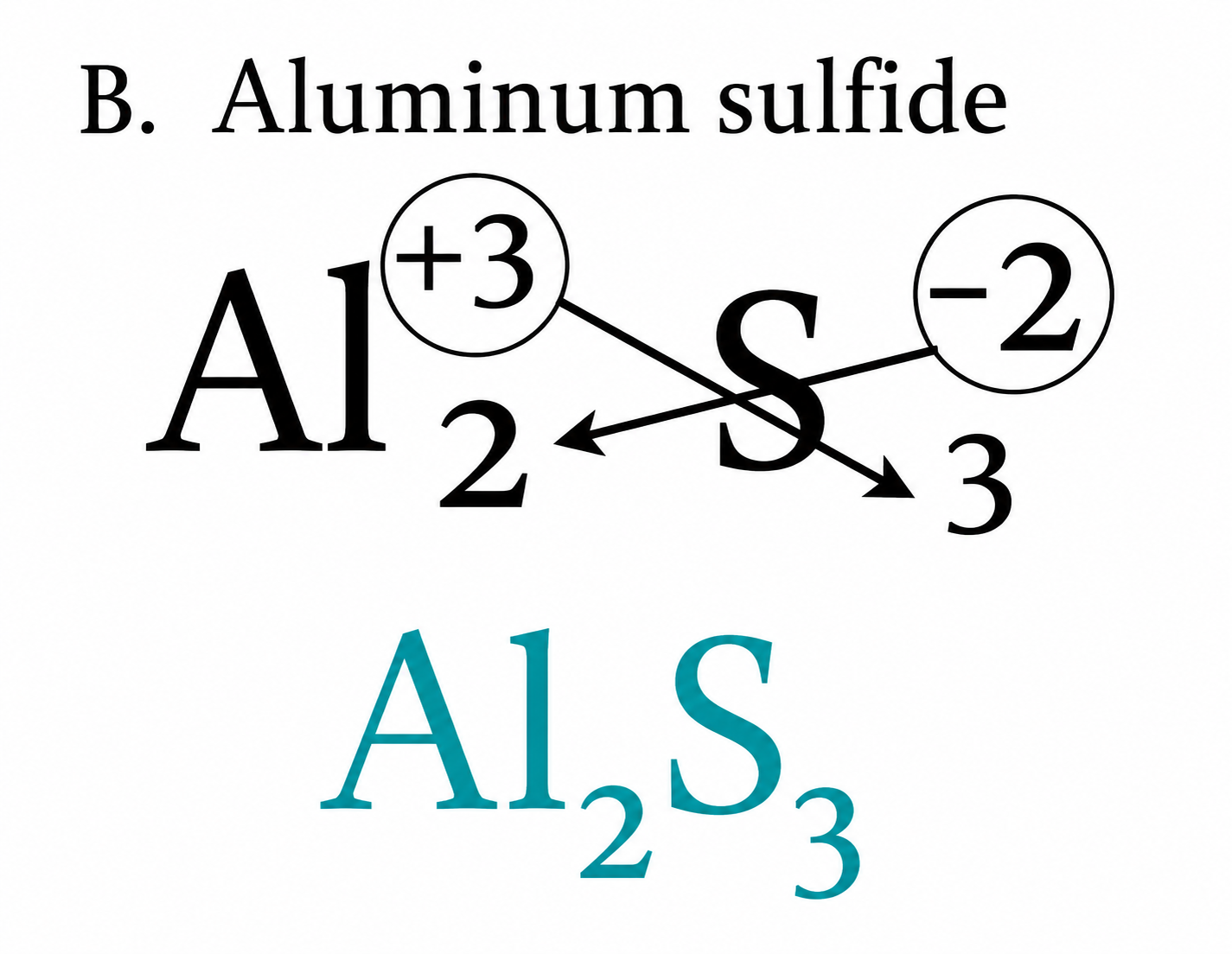
The chemical formula for aluminum sulfide is Al₂S₃. This formula shows that the compound is made of two aluminum ions (Al³⁺) and three sulfide ions (S²⁻). Aluminum has a +3 charge, while sulfur has a -2 charge. To balance these charges and form a neutral compound, two aluminum ions combine with three sulfide ions. This is why the correct formula is Al₂S₃. The formula is a classic example used to explain how ionic compounds are formed based on charge neutrality and valency rules in chemistry.
Composition of Aluminum Sulfide
Aluminum sulfide is composed of aluminum and sulfur elements. Aluminum is a metal, while sulfur is a non-metal. When these elements react, electrons are transferred from aluminum to sulfur, forming ions. Aluminum becomes positively charged (Al³⁺), and sulfur becomes negatively charged (S²⁻). The electrostatic attraction between these ions forms a strong ionic compound. This composition helps explain how metals and non-metals interact to create stable chemical compounds.
Structure of Aluminum Sulfide
Aluminum sulfide has a crystalline ionic structure. In this structure, aluminum and sulfur ions are arranged in a repeating lattice pattern. The ions are held together by strong electrostatic forces between positive and negative charges. This lattice structure gives the compound stability in solid form. The structure also explains why aluminum sulfide has a high melting point and specific physical properties. Like many ionic compounds, its structure is rigid and well-organized.
Formation of Aluminum Sulfide
Aluminum sulfide is formed by the direct combination of aluminum and sulfur at high temperatures. When aluminum metal reacts with sulfur, a chemical reaction occurs that produces Al₂S₃. This reaction is exothermic, meaning it releases heat energy. The formation process is often demonstrated in laboratories to help students understand synthesis reactions. The balanced chemical reaction shows how elements combine in fixed ratios to form a compound with a specific chemical formula.
Physical Properties of Aluminum Sulfide
Aluminum sulfide is a solid compound at room temperature and usually appears as a crystalline substance. It is not stable in the presence of moisture and can decompose when exposed to water. During decomposition, it may release hydrogen sulfide gas, which has a strong unpleasant smell. It is generally insoluble in water and has a high melting point due to strong ionic bonding. These physical properties make it suitable mainly for controlled laboratory environments.
Chemical Properties of Aluminum Sulfide
Aluminum sulfide reacts with water to produce aluminum hydroxide and hydrogen sulfide gas. This reaction shows that it is highly sensitive to moisture. It also reacts with acids, producing aluminum salts and hydrogen sulfide gas. These reactions are important because they demonstrate typical behavior of metal sulfides. Due to its reactivity with water and acids, aluminum sulfide must be handled carefully under dry conditions in laboratories.
Preparation of Aluminum Sulfide
Aluminum sulfide is usually prepared by heating aluminum metal with sulfur powder at high temperatures. During this process, both elements combine directly to form Al₂S₃. The reaction must be controlled because it can release a significant amount of heat. This preparation method is commonly used in educational laboratories to demonstrate compound formation. It also helps students understand how elements react based on their chemical properties and valency.
Uses of Aluminum Sulfide
Aluminum sulfide has limited practical applications in industry. It is mainly used in chemistry education and laboratory experiments. It helps students learn about ionic bonding, chemical equations, and stoichiometry. Researchers may also study it to understand the behavior of metal sulfides. Due to its instability in moisture, it is not widely used in commercial applications, but it remains important in academic studies.
Safety Considerations
Aluminum sulfide must be handled carefully because it reacts with water to release hydrogen sulfide gas, which is toxic and has a strong odor. Proper safety equipment such as gloves, goggles, and lab ventilation is required when working with this compound. Direct contact with moisture should be avoided. Safe handling practices are essential to prevent exposure to harmful gases and ensure laboratory safety.
Environmental Impact
Aluminum sulfide is not commonly found in nature in large quantities. However, its reaction with water can release hydrogen sulfide gas, which can be harmful to the environment in high concentrations. Because of this, proper disposal and controlled use in laboratories are important. Its environmental impact is generally low due to limited usage, but safety precautions are still necessary.
Importance in Chemistry
The chemical formula for aluminum sulfide (Al₂S₃) is important in chemistry education because it helps explain how ionic compounds are formed. It is used to teach valency, charge balance, and chemical bonding. It also helps students understand how to write correct chemical formulas. This makes it a valuable example in basic inorganic chemistry learning.
Comparison with Other Metal Sulfides
Aluminum sulfide is similar to other metal sulfides like iron sulfide and zinc sulfide. However, it is less stable in the presence of water compared to many other sulfides. While some sulfides have industrial uses, aluminum sulfide is mainly used for educational purposes. This comparison helps students understand differences in stability and chemical behavior among similar compounds.
Limitations of Aluminum Sulfide
One major limitation of aluminum sulfide is its instability in moist conditions. It easily decomposes when exposed to water. It also releases hydrogen sulfide gas, which makes it difficult to handle safely outside controlled environments. Due to these limitations, it has very limited industrial use and is mainly restricted to laboratory studies.
Future Research
Although aluminum sulfide is not widely used in industry, it is still studied in chemical research. Scientists use it to understand reaction mechanisms and bonding behavior in ionic compounds. Future studies may explore ways to stabilize similar compounds or use sulfide materials in advanced chemical applications and materials science research.
Conclusion
The chemical formula for aluminum sulfide is Al₂S₃. It is an ionic compound formed from aluminum and sulfur through charge balance and electron transfer. Although it has limited industrial use, it plays an important role in chemistry education. It helps explain fundamental concepts such as valency, ionic bonding, and chemical structure. Understanding its formula and properties is essential for building a strong foundation in inorganic chemistry.



 English
 Arabic
 French
 Russian